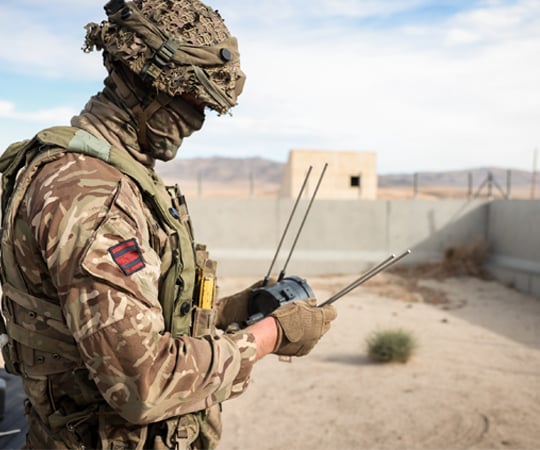
We’re proud of how far we’ve come since we were founded, and of what we’ve achieved to help transform training for the Royal Engineers. Our next chapter will continue to be defined by effectiveness and innovation, but with an even wider remit.
Explore some key milestones and accolades on our journey from formation and into the future.
We began a 30-year Public Private Partnership (PPP) with the Ministry of Defence as part of the Holdfast Training Services (HTS) consortium to modernise training and training management for the Royal Engineers. Prior to our involvement, the trainee pass rate was around 84%, trainee satisfaction less than 75% and less than 50% of our trainers were qualified to level 5 in teaching.
We quickly adopted the Defence Systems Approach to Training (DSAT) and initiated a training transformation for the Royal School of Military Engineering (RSME) including investment in learning technology, updated course structure and content, and student-centred trainer development[P.
We won the Queen’s Anniversary Prize for providing innovative engineering and construction training for the British Army, producing a major contribution to the local economy.
We signed up to the Armed Forces Covenant voluntary pledge to uphold the principles of the Armed Forces and demonstrate support for the Armed Forces community.
We won the Queen’s Anniversary Prize for Higher and Further Education, and both City and Guilds Centre of the Year and Instructor of the Year.
The next phase of our ongoing training transformation got underway, including eLearning, TEL and accelerated learning with Fixed Mastery Variable Timing (FMVT) – where experienced learners and those most adept have the opportunity to complete their training faster, and so return to their unit sooner.
As part of our commitment to accessible learning, we introduced 56 online training resources for the City & Guilds SmartScreen learning platform. Nine years into the PPP contract, improvements were clear – the trainee pass rate was 95% and satisfaction 97%, we had reduced total training time by 20%.
When COVID-19 lockdown was initiated, we rapidly rolled out remote learning with only 3 days’ disruption to training. In support of the national effort, we continued to train the Royal Engineers. We also offered training to soldiers tasked with constructing the Nightingale hospital in London. In addition, roadgoing vehicles were adapted for use as mobile vaccination vehicles by our Fabrication programme area.
We won several prestigious awards: the Princess Royal Training Award for our innovative Early Careers development scheme; Gold in the Defence Employer Recognition Scheme linked to the Royal Forces Covenant; and the [PC3.1]Chartered Institute of Building Services Engineers Happold Brilliant Award; our students won the Chartered Institute of Building Challenge; and we were recognised in the Kent Employer of the Year awards.
We launched our Defence Growth business unit to apply our expertise and explore how we could support wider defence, adjacent sectors with innovative learning and training solutions.
In recognition of our world-leading health and safety practice, we won not only our 14th[PC4.1] consecutive RoSPA Gold Award but the RoSPA President’s Award winner too.
And at the halfway mark of our RSME contract, we had delivered significant results: 100% attributable pass rate; 100% overall trainee satisfaction;
3990 training days saved; 0 KPI financial penalties; all trainers qualified to a minimum level 5 teaching standard.
We won our 15th consecutive RoSPA Gold Award. As a Princess Royal Award Alumni, we’re supporting other organisations on their quest for awards.
Looking ahead, we’re motivated by the opportunity to help our clients solve their training challenges, and make faster progress to operational readiness.
The Corps of Royal Engineers, commonly known as the Sappers, are combat soldiers with technical engineering skills and have a role in every area of the battlefield. At the front they support the rest of the Army, bridging rivers, using explosives to destroy bridges or clearing routes through minefields. Behind the frontline they improve transport routes, construct camps, build runways and carry out bomb disposal. They also use their specialist skills to help rebuild after the conflict. MKC Training exists to train these skills.
Since medieval times, builders and engineers had formed part of British armies. An officer-only Corps of Engineers was constituted in 1716. In 1812, this unit’s name was changed to the Corps of Royal Sappers (from the French 17th-century French verb saper, to undermine or dig) and Miners. Sappers dug tunnels into the Rock of Gibraltar to help defend the strait.
In 1962 the School of Military Engineering celebrated its 150th birthday, and as a birthday present The Queen bestowed the Royal title on the School, becoming The Royal School of Military Engineering (RSME).
Brompton Barracks in Kent, where we deliver most of RSME training, was established in 1812 and has been a campus for professional, technical and artisan trade training for the Royal Engineers ever since.
In 1667, during the second Anglo-Dutch war, a Dutch raiding force sailed into the Medway, burning 13 ships and towing away two, including the flagship HMS Royal Charles. As a result of this, records show that there has been a military base on the high ground above Chatham since at least 1708, built to defend Chatham Dockyard from future incursions.
The site has steadily been built upon – for example, the School House and Lecture Theatre were built in 1861, and The Institute Building, built in 1872, now houses HQ RSME. Brompton Barracks Gymnasium is one of the earliest surviving British Army gymnasiums, built in 1863, and was Grade II* listed in 1998.
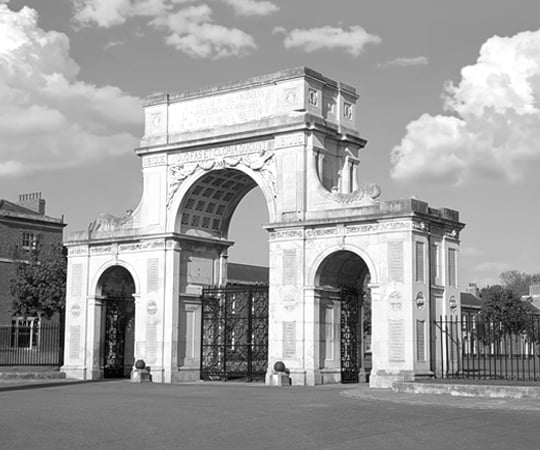
Brompton Barracks is also home to several statues and memorials, including the Crimean Memorial Arch built in 1856, and the South African Arch which was erected in memory of all Royal Engineers killed during the Boer Wars and unveiled by King Edward VII in 1905. The statue of General Gordon of Khartoum was commissioned by the Corps, exhibited at the Royal Academy in 1890, and then moved to Brompton Barracks.
Today, thousands of Royal Engineers complete training and qualifications in construction, engineering and watermanship at Brompton Barracks.
Whatever the situation you need to deal with, we can find a way. Conversation is always the starting point. So let’s talk.


©MKC Training Services Limited 2026 All rights reserved.